Tell us about the job
Takes about a minute. No obligation.
Sizing a boiler correctly for this house is the first thing a contractor has to settle before anything else on the quote makes sense. Homes in Sherman County, OR run heat about eight months a year, from October through May. A burner that runs through that span cycles its ignition system, heat exchanger, and flue connections repeatedly, and a unit that was underspecified at installation accumulates that wear faster than the load calculation assumed. Joints that were not sealed properly and heat exchangers working harder than their rated output will show stress sooner here than they would somewhere the equipment sits idle for most of the year. The install quality sets the ceiling on how long the equipment lasts.
Ductwork that was sized and routed for an earlier generation of heating equipment does not automatically carry a modern boiler's output, and in Sherman County that gap is where most installation decisions get made. Half the homes in Sherman County, Oregon were built in 1960 or earlier (2020-2024 ACS 5-year). A contractor assessing a job here opens the distribution system first, not last, because what the existing runs can handle sets the scope before any equipment is priced. If the ductwork needs to be modified or supplemented, that work shapes the quote more than the boiler unit itself does.
What a Boiler Installation Puts in Your Home
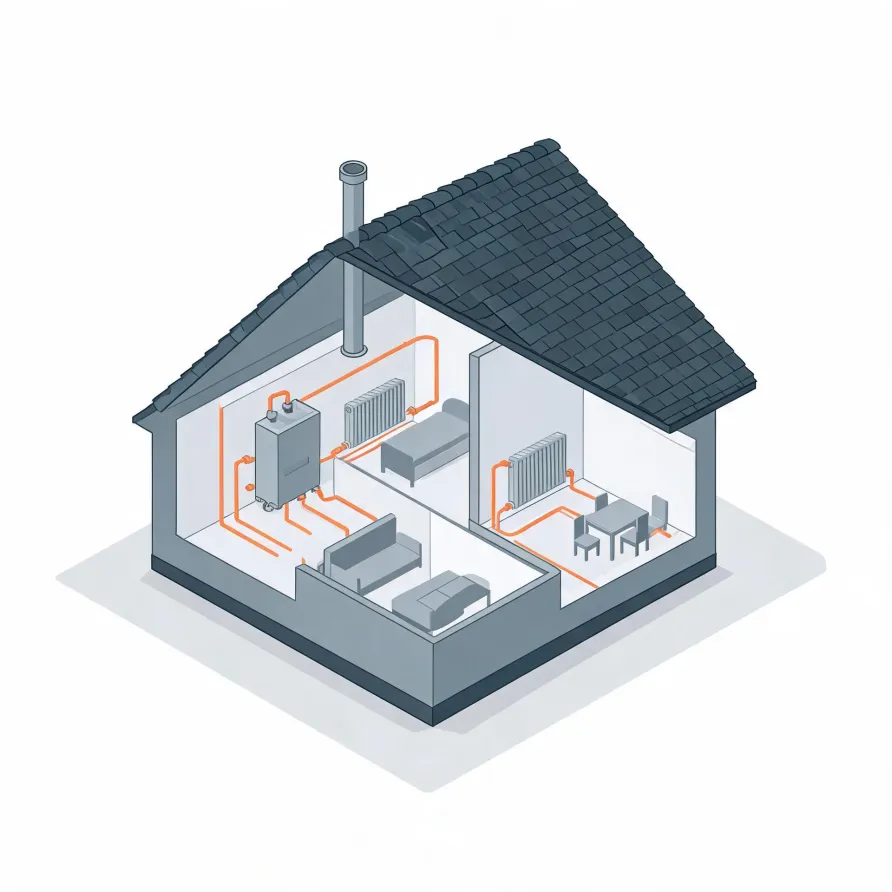
The boiler itself sits in a mechanical room, basement, or utility closet and is the unit that heats water for the whole system. Wall-mounted or floor-standing depending on the house, it connects to a flue that runs to the exterior. The thermostat goes on a main living-area wall and signals the boiler when to fire.
From the boiler, a network of pipes runs through the house to radiators or radiant floor loops in each zone, with each radiator sitting against an exterior wall or beneath a window. A circulation pump, mounted close to the boiler, moves the heated water through those pipes. An expansion tank and pressure relief valve sit alongside the boiler as well, keeping the closed system at a safe operating pressure.
The drawing shows the general layout of a boiler system, and a licensed contractor determines exactly what applies to this house.
Get matched in Sherman CountySherman County, Oregon, by the numbers
67 severe weather events were recorded in Sherman County, Oregon between 2015 and 2024.
NOAA National Centers for Environmental Information, Storm Events Database, bulk CSV export, events 2015-01-01 through 2024-12-31.Half the homes in Sherman County, Oregon were built in 1960 or earlier (2020-2024 ACS 5-year).
U.S. Census Bureau, 2020-2024 American Community Survey 5-Year EstimatesSherman County, Oregon holds 969 housing units (2020-2024 ACS 5-year).
U.S. Census Bureau, 2020-2024 American Community Survey 5-Year EstimatesOwners occupy 65.9% of the occupied homes in Sherman County, Oregon (2020-2024 ACS 5-year).
U.S. Census Bureau, 2020-2024 American Community Survey 5-Year EstimatesBoiler Installation Rules on the Books for Sherman County, Oregon2 sourced standards and codes
Licensing and Legal Requirements in Sherman County, Oregon
Oregon’s contractor licence does not reach casual, minor or inconsequential work on one structure where the person’s contracts total less than $1,000 — and the exemption is unavailable to anyone who advertises or signs themselves as a contractor, at any price.
Oregon requires a current Construction Contractors Board licence, with the right endorsement, to undertake, offer to undertake or bid construction work.
Severe Weather Events in Sherman County
Heating equipment in Sherman County works against the local climate, not a generic one. How hard that climate pushes determines what a boiler here needs to handle, which is why weather history belongs on a page about installation.
67 severe weather events, 2015–2024. Source: NOAA National Centers for Environmental Information, Storm Events Database.