Tell us about the job
Takes about a minute. No obligation.
A boiler in this area runs its burner and ignition system hard, and the wear shows up there first. Homes in Coos County, OR run heat about nine months a year, from October through June. After that many months of cycling on and off, the igniter, the heat exchanger, and the burner assembly are the parts a contractor opens before anything else, because that is where the load actually lands. Seals and gaskets that took repeated thermal expansion follow closely behind. A service call that starts anywhere else is working backward.
Boiler parts are only as available as the system that takes them. Half the homes in Coos County, Oregon were built in 1974 or earlier (2020-2024 ACS 5-year). A house of that vintage has likely had its boiler swapped at least once, but the replacement that went in may itself be old enough that gaskets, heat exchangers, and control boards for it are no longer in regular production. A contractor opening a failed unit here checks manufacturer support before pricing the repair, because a part that exists in a catalog and a part a distributor can actually ship are two different things.
The Parts of a Boiler a Contractor Checks First
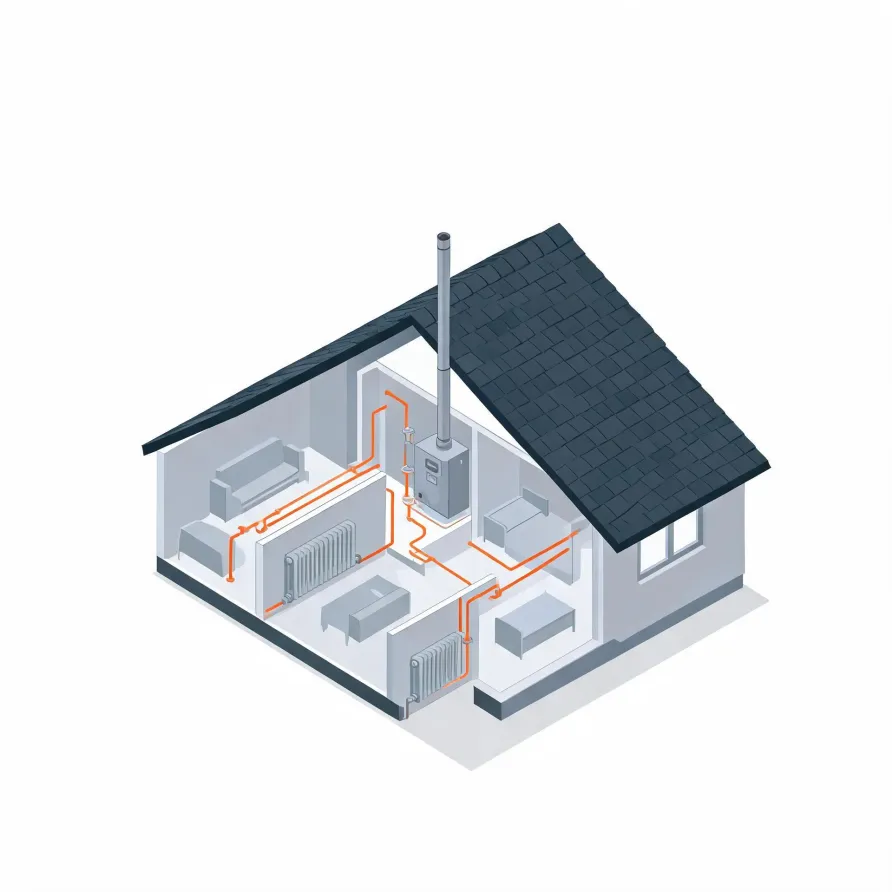
The boiler itself sits in a utility room, basement, or mechanical closet and is the piece a contractor goes to first. It houses the burner, the heat exchanger, and the controls that regulate firing and water temperature. When heat is uneven, the house won't warm up, or the system short-cycles, one of those internal components is usually where the fault lives.
Radiators or baseboard units sit in the living spaces and are what a homeowner notices when something feels off. Connecting them to the boiler is a network of pipes, along with a circulator pump that moves the heated water through the loop and an expansion tank that keeps pressure stable. The circulator and the pressure relief valve are both parts a contractor examines closely when the system shows signs of low heat or pressure problems.
The drawing shows a typical boiler system layout, and a licensed contractor determines which components and conditions apply to your specific home.
Get matched in Coos CountyCoos County, by the record
98 severe weather events were recorded in Coos County, Oregon between 2015 and 2024.
NOAA National Centers for Environmental Information, Storm Events Database, bulk CSV export, events 2015-01-01 through 2024-12-31.Half the homes in Coos County, Oregon were built in 1974 or earlier (2020-2024 ACS 5-year).
U.S. Census Bureau, 2020-2024 American Community Survey 5-Year EstimatesCoos County, Oregon holds 31,905 housing units (2020-2024 ACS 5-year).
U.S. Census Bureau, 2020-2024 American Community Survey 5-Year EstimatesOwners occupy 71.2% of the occupied homes in Coos County, Oregon (2020-2024 ACS 5-year).
U.S. Census Bureau, 2020-2024 American Community Survey 5-Year EstimatesBoiler & HVAC Repair Rules on Record for Coos County, Oregon2 codes, standards & regulations
Licensing and Legal Requirements in Coos County, Oregon
Oregon’s contractor licence does not reach casual, minor or inconsequential work on one structure where the person’s contracts total less than $1,000 — and the exemption is unavailable to anyone who advertises or signs themselves as a contractor, at any price.
Oregon requires a current Construction Contractors Board licence, with the right endorsement, to undertake, offer to undertake or bid construction work.
Severe Weather Events in Coos County
Boilers work harder when outside conditions push the building's heat load to its limits, and that kind of strain accumulates over time. How often severe weather hits Coos County is a real factor in how much a boiler here is asked to do.
98 severe weather events, 2015–2024. Source: NOAA National Centers for Environmental Information, Storm Events Database.