Tell us about the job
Takes about a minute. No obligation.
A boiler in this house has been cycling its burner and firing its ignition system through a long stretch of the calendar every year. Homes in Jackson County, OR run heat about nine months a year, from October through June. The heat exchanger and ignition components absorb that load cycle by cycle, and by the time something fails, the contractor is looking at parts with real hours on them. A faulty igniter or a cracked exchanger here reflects accumulated wear, and a repair quote that skips checking the adjacent components is working off incomplete information.
Boilers in stock this old carry heat exchangers, burner assemblies, and piping that have run through decades of freeze and thaw cycles specific to southern Oregon's elevation range. Half the homes in Jackson County, Oregon were built in 1985 or earlier (2020-2024 ACS 5-year). What that age means for repair is concrete: once a contractor opens the unit, the question is whether the failed component still has a supply chain behind it, or whether the part exists only as old stock. A heat exchanger that has cracked, a gas valve whose replacement has been discontinued, or a circulator pump in an obsolete size each changes what the repair costs and whether it finishes in one visit.
The Parts of a Boiler a Contractor Checks First
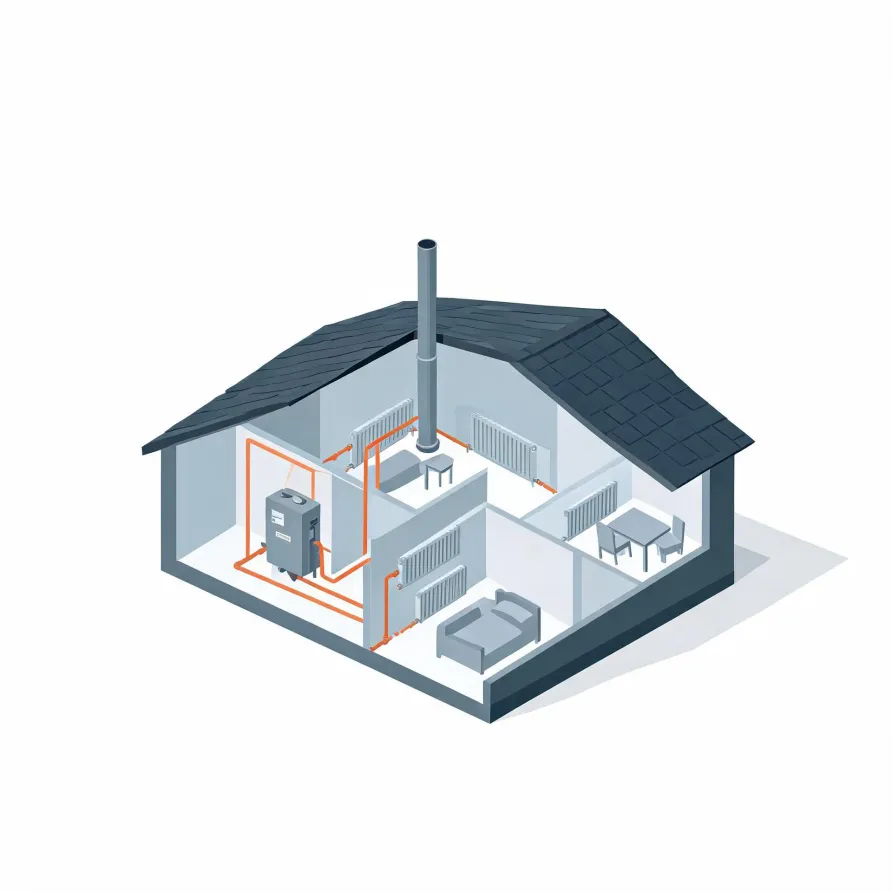
The boiler itself sits in a mechanical room, basement, or utility closet and is where water gets heated before it moves through the house. A contractor starts here, looking at the heat exchanger, the burner assembly, and the pressure vessel for signs of failure, corrosion, or blocked combustion.
From the boiler, a pump pushes hot water through supply pipes to radiators or radiant floor loops in each room, and a separate return line carries cooled water back. The expansion tank, usually mounted near the boiler, absorbs pressure swings, and the pressure relief valve sits on the boiler as a safety device. Both get close attention when something in the system is behaving wrong.
The drawing shows a typical boiler layout, and a licensed contractor will assess which components apply to your specific setup.
Get matched in Jackson CountyJackson County, Oregon, by the numbers
142 severe weather events were recorded in Jackson County, Oregon between 2015 and 2024.
NOAA National Centers for Environmental Information, Storm Events Database, bulk CSV export, events 2015-01-01 through 2024-12-31.Half the homes in Jackson County, Oregon were built in 1985 or earlier (2020-2024 ACS 5-year).
U.S. Census Bureau, 2020-2024 American Community Survey 5-Year EstimatesJackson County, Oregon holds 97,991 housing units (2020-2024 ACS 5-year).
U.S. Census Bureau, 2020-2024 American Community Survey 5-Year EstimatesOwners occupy 65.9% of the occupied homes in Jackson County, Oregon (2020-2024 ACS 5-year).
U.S. Census Bureau, 2020-2024 American Community Survey 5-Year EstimatesCodes & Standards Governing Boiler and HVAC Repair in Jackson County, Oregon2 sourced rules and standards
Licensing and Legal Requirements in Jackson County, Oregon
Oregon’s contractor licence does not reach casual, minor or inconsequential work on one structure where the person’s contracts total less than $1,000 — and the exemption is unavailable to anyone who advertises or signs themselves as a contractor, at any price.
Oregon requires a current Construction Contractors Board licence, with the right endorsement, to undertake, offer to undertake or bid construction work.
Severe Weather Events in Jackson County
Hard weather puts hours on a boiler fast, cycling it through demands it was not built to absorb in a short stretch. How much of that a system sees depends entirely on where it sits, which is why local conditions are part of the repair picture in Jackson County.
142 severe weather events, 2015–2024. Source: NOAA National Centers for Environmental Information, Storm Events Database.