Tell us about the job
Takes about a minute. No obligation.
A contractor quoting a boiler installation in Deschutes County has to size the system for a burner and heat exchanger that almost never rest. Homes in Deschutes County, OR run heat about ten months a year, from September through June. That kind of continuous cycling loads the ignition system, the burner assembly, and the seals around the heat exchanger in a way that punishes any gap in the installation. A boiler that is undersized by even a small margin will short-cycle or overrun to compensate, and the parts that pay for that are the ones already under the most stress. Contractors working this county price and spec accordingly, because the season does not give a poorly installed boiler anywhere to hide.
Ductwork and electrical panels installed when a house was first built were sized for the equipment that went in at the time. A contractor quoting a boiler installation here checks both against what a new unit will actually draw and push, because the gap between the two is where a job gets complicated. Half the homes in Deschutes County, Oregon were built in 1998 or earlier (2020-2024 ACS 5-year). That means the existing infrastructure in a notable portion of local homes was designed around equipment generations removed from what a contractor brings to the job today, and what the panels and ducts can carry determines what gets specified.
What a Boiler Installation Puts in Your Home
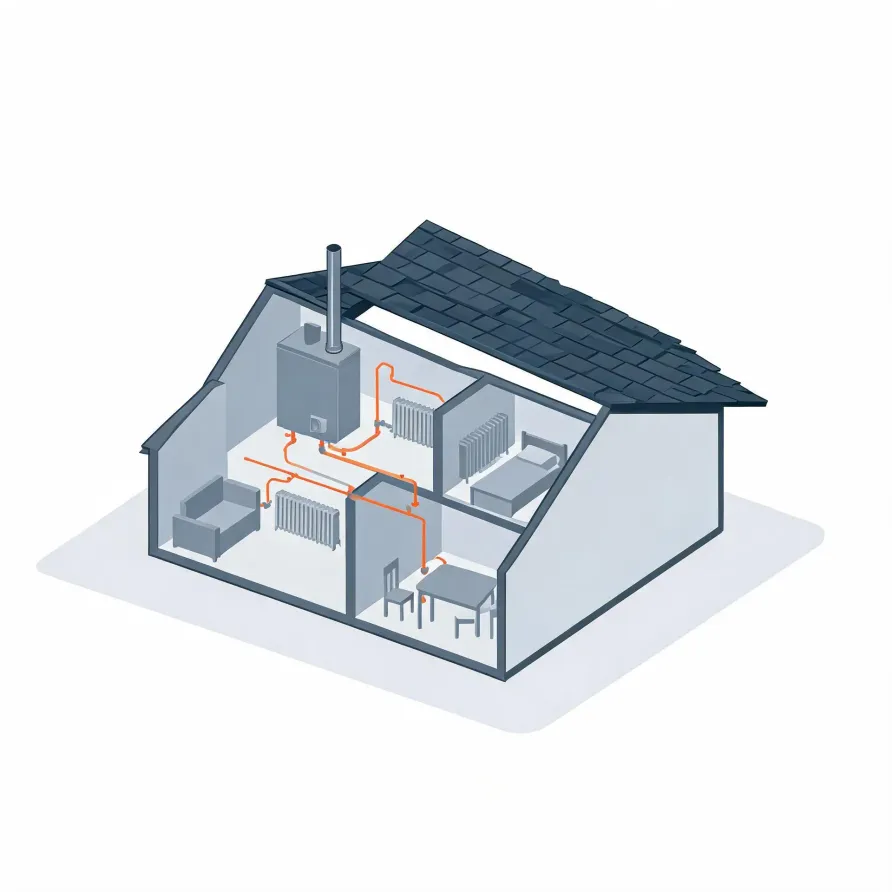
The boiler itself sits in a mechanical room, basement, or utility closet and is where water gets heated before it moves through the house. Paired with it is the expansion tank, which absorbs pressure changes in the system and mounts directly alongside the boiler. Together these two pieces form the heart of what a contractor sets in place.
From the boiler, copper or PEX supply lines run through the house to the heat emitters, whether those are baseboard radiators along exterior walls or radiant tubing laid beneath the floor. The circulator pump, mounted on the piping near the boiler, pushes the heated water through that loop and back again. A pressure relief valve and shutoff valves go in at the boiler itself to give the system safe operating limits and service access.
The drawing shows the general layout of a boiler system, and a licensed contractor determines exactly which components apply to your house and how they connect.
Get matched in Deschutes CountyDeschutes County, by the numbers
135 severe weather events were recorded in Deschutes County, Oregon between 2015 and 2024.
NOAA National Centers for Environmental Information, Storm Events Database, bulk CSV export, events 2015-01-01 through 2024-12-31.Half the homes in Deschutes County, Oregon were built in 1998 or earlier (2020-2024 ACS 5-year).
U.S. Census Bureau, 2020-2024 American Community Survey 5-Year EstimatesDeschutes County, Oregon holds 99,297 housing units (2020-2024 ACS 5-year).
U.S. Census Bureau, 2020-2024 American Community Survey 5-Year EstimatesOwners occupy 70.0% of the occupied homes in Deschutes County, Oregon (2020-2024 ACS 5-year).
U.S. Census Bureau, 2020-2024 American Community Survey 5-Year EstimatesBoiler Installation Rules on the Books for Deschutes County, Oregon2 sourced standards and codes
Licensing and Legal Requirements in Deschutes County, Oregon
Oregon’s contractor licence does not reach casual, minor or inconsequential work on one structure where the person’s contracts total less than $1,000 — and the exemption is unavailable to anyone who advertises or signs themselves as a contractor, at any price.
Oregon requires a current Construction Contractors Board licence, with the right endorsement, to undertake, offer to undertake or bid construction work.
Severe Weather Events in Deschutes County
Deschutes County weather puts real demands on heating equipment, and those demands shape what a boiler installation here needs to handle. A unit sized and specified for local conditions lasts longer and costs less to run than one treated as a generic replacement.
135 severe weather events, 2015–2024. Source: NOAA National Centers for Environmental Information, Storm Events Database.