Tell us about the job
Takes about a minute. No obligation.
Sizing a boiler for Klamath County starts with how little time the system actually spends off. Homes in Klamath County, OR run heat about ten months a year, from September through June. The burner and heat exchanger cycle through that work without the long summer breaks that spare equipment in shorter seasons. A contractor quoting a replacement here has to establish the load the house actually puts on the system before settling on output, because a unit that is even slightly undersized runs harder and longer than it should, accelerating wear on the ignition system and the heat exchanger alike. Sloppy installation compounds that: a boiler that is not properly commissioned from the start has fewer dormant months to hide the problem.
Existing ductwork is what a boiler installation turns on in this county. Half the homes in Klamath County, Oregon were built in 1974 or earlier (2020-2024 ACS 5-year). Stock that old was built around equipment long since replaced, and the ductwork laid in for that original equipment carries the dimensions, the routing, and the flow capacity of a different era. A contractor sizing a new boiler has to assess what those ducts will actually deliver before anything else on the job can be priced or planned. The electrical is a separate question, but the ductwork is where the answer about feasibility lives.
What a Boiler Installation Puts in Your Home
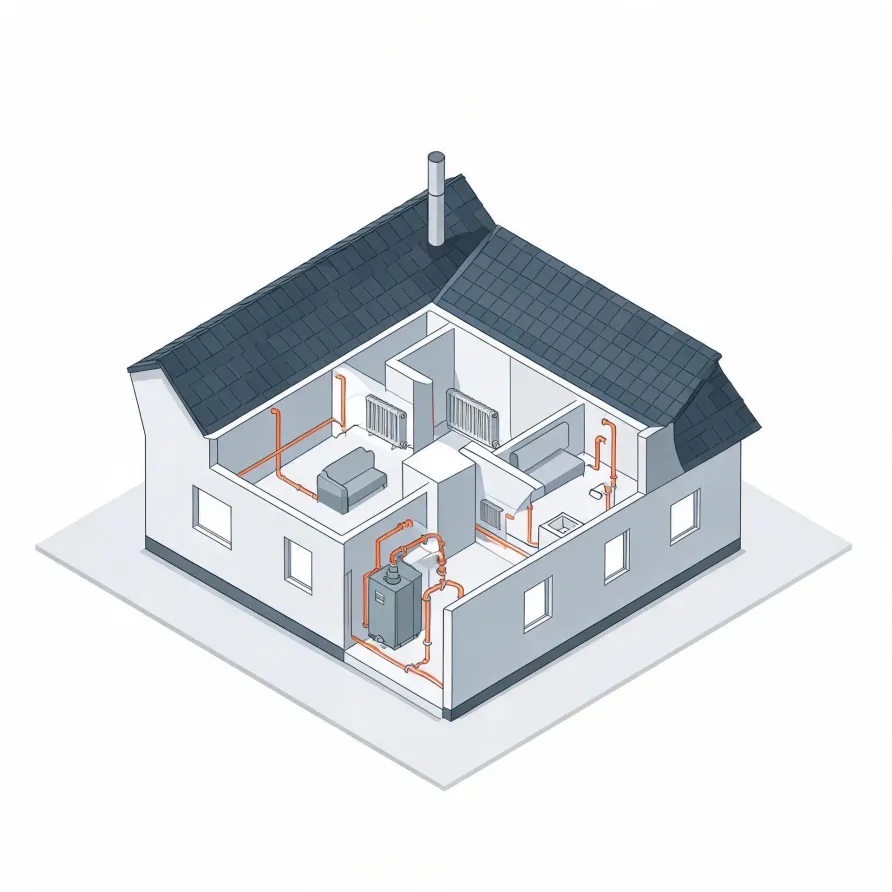
The boiler itself sits in a mechanical room, basement, or utility closet and is the unit that heats water for the whole system. Wall-hung models mount directly to a wall; floor-standing units rest on the floor beside the plumbing connections. Either way, this is the piece a contractor sizes and sets first.
From the boiler, supply and return pipes run through the house to radiators, baseboard units, or radiant floor loops, each of which releases heat into its room. A circulator pump, mounted close to the boiler, keeps water moving through those pipes. An expansion tank and pressure relief valve sit nearby on the supply line to keep system pressure in a safe range.
The drawing shows a typical boiler layout, and a licensed contractor determines exactly which components and configurations apply to your home.
Get matched in Klamath CountyKlamath County, by the numbers
165 severe weather events were recorded in Klamath County, Oregon between 2015 and 2024.
NOAA National Centers for Environmental Information, Storm Events Database, bulk CSV export, events 2015-01-01 through 2024-12-31.Half the homes in Klamath County, Oregon were built in 1974 or earlier (2020-2024 ACS 5-year).
U.S. Census Bureau, 2020-2024 American Community Survey 5-Year EstimatesKlamath County, Oregon holds 33,162 housing units (2020-2024 ACS 5-year).
U.S. Census Bureau, 2020-2024 American Community Survey 5-Year EstimatesOwners occupy 69.4% of the occupied homes in Klamath County, Oregon (2020-2024 ACS 5-year).
U.S. Census Bureau, 2020-2024 American Community Survey 5-Year EstimatesBoiler Installation Rules for Klamath County, Oregon2 sourced codes and standards
Licensing Rules for Klamath County, Oregon
Oregon’s contractor licence does not reach casual, minor or inconsequential work on one structure where the person’s contracts total less than $1,000 — and the exemption is unavailable to anyone who advertises or signs themselves as a contractor, at any price.
Oregon requires a current Construction Contractors Board licence, with the right endorsement, to undertake, offer to undertake or bid construction work.
Severe Weather Events in Klamath County
Boilers work hardest when outside conditions demand the most from them. How often that happens in Klamath County shapes what a well-sized, properly installed system needs to handle.
165 severe weather events, 2015–2024. Source: NOAA National Centers for Environmental Information, Storm Events Database.